Looking for LGBTQ+ Africa at the Indaba travel convention
At Africa's biggest travel trade show, there are few rainbow flags, but more LGBTQ+ Africa than you might expect
Written by
Paul Gallant
August 7, 2024 last updated May 6, 2026
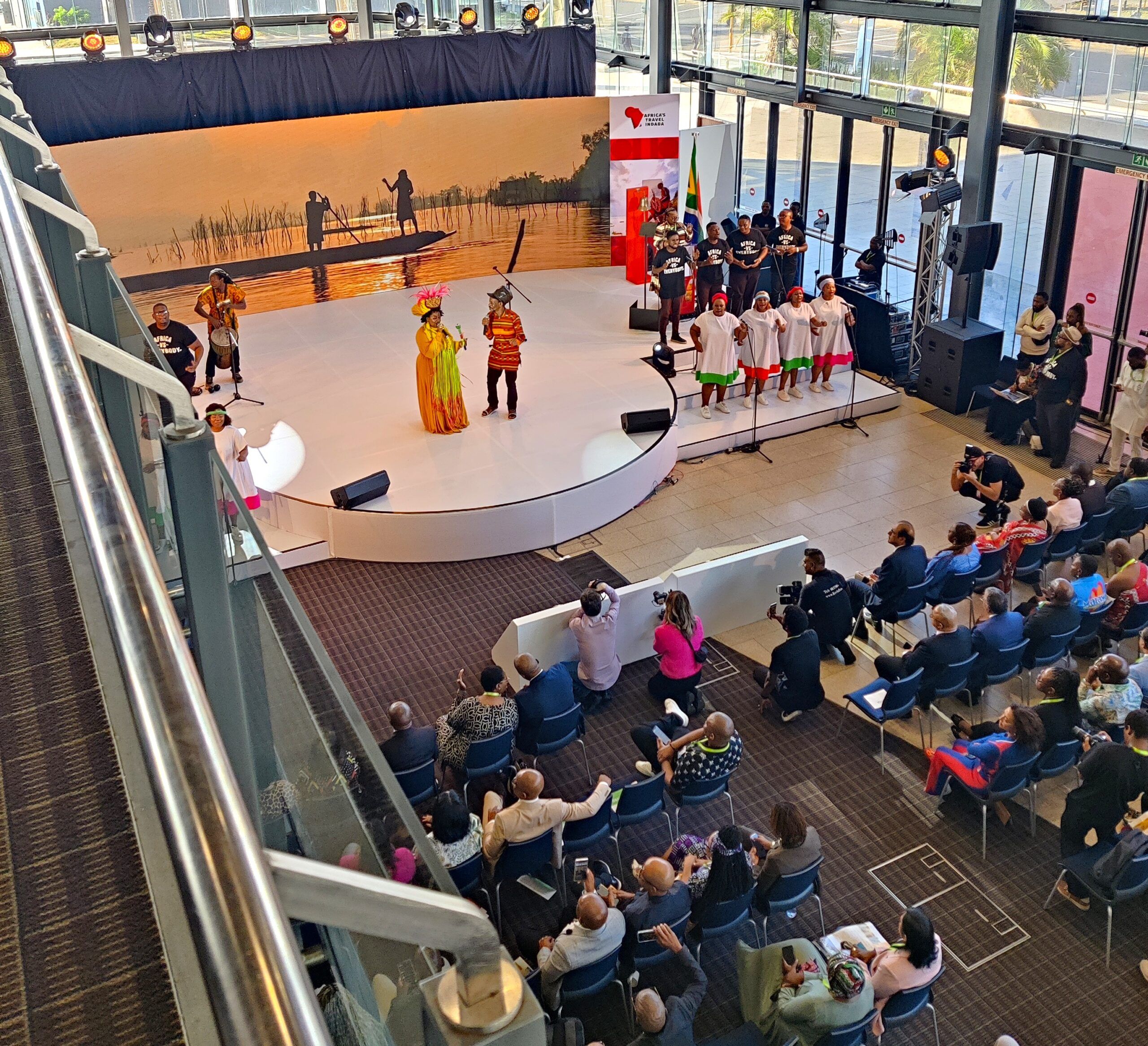
A performance during the Travel Indaba in Durban, South Africa, a convention of travel buyers and suppliers from across Africa and the world.
When it comes to LGBTQ+ travel in Africa, there’s a stereotype that the countries fall into two camps: One camp is South Africa and the other is everybody else.
And that’s certainly true when it comes to laws, policies and what I’ll call LGBTQ+ infrastructure—community groups and resources, travel companies, recreational venues like bars and clubs, businesses run by and for queer people, and queer inclusion in arts, culture and public life. South Africa stands out among the 54 African nations as taking its “rainbow nation” slogan very seriously.
I’ve already written about Cape Town and we will be publishing more Pink Ticket Travel stories about South Africa—the country’s got a lot worth covering. But as a guest of South Africa Tourism at this year’s Africa’s Travel Indaba, a three-day trade show dedicated to the travel industry across the continent, I was able to get an overview of what’s happening in “the other camp”—that is, the rest of Africa. And it’s more layered and complex than you’d expect by looking at each country’s legal and political landscape. Horrifying headlines don’t tell you everything.
Advertisement
The Travel Indaba, hosted in the South African city of Durban, is huge: about 1,200 exhibitors from 25 African countries get a chance to meet with about 1,000 buyers (that is, companies that package and book holidays) from 55 countries, many of them from rich places in Europe and North America. A New York travel agent might be looking for a supplier, say, for a new five-star hotel that can accommodate big groups in Angola, while a tour company in France might be looking for a supplier of safaris in Kenya that can provide eco-friendly excursions for small groups.
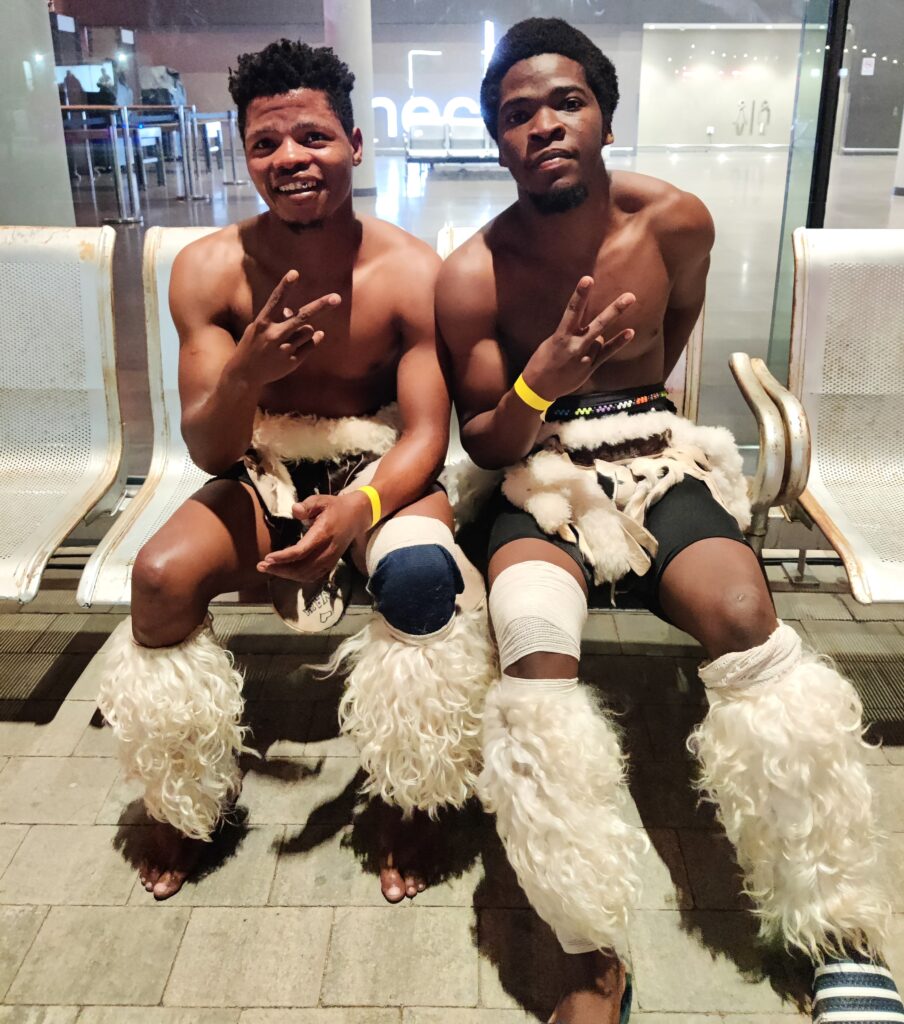
Two performers during a party at the Indaba travel convention in Durban 2024.
And then there’s me, looking for the L, the G, the B, the T and the plus, particularly beyond the borders of South Africa, where the hunting is easier. (Because I was with a delegation hosted by Visit South Africa, I was introduced to several delightful South African industry types.)
There were many caveats to my mission. I’m a tall white guy who dresses pretty conservatively, and I did not run from booth to booth declaring, “I’m gay, how are the locals going to treat me if I visit your destination, accommodation or attraction?” Attendees are mostly public-facing hospitality professionals—being friendly, nonjudgmental, non confrontational and accommodating is in their DNA. They know how to stay on message and avoid uncomfortable moments.
Advertisement
Whether justified or not, visitors from richer countries often find developing countries daunting to travel in; transportation, accommodation and dining can be trickier to navigate. So there’s a tendency for African travel to be sold as “complete experiences,” where a tour company or travel agent works with suppliers according to the criteria they’re selling—a certain level of luxury, a certain level of adventure, a certain demographic, etc.—and then provides an almost seamless experience from the arrival flight to the departure flight. LGBTQ+ travellers are included among those demographics by buyers who are shopping for queer, queer-friendly and, at minimum, queer-safe suppliers. Companies like Cape Town–based Afrigay Traveland Durban-based Pinqtravel, which both cater primarily to gay men, dedicate much of their time at Indaba, and in their follow-up meetings, to feeling out exhibitors’ attitudes, and suggesting and asking for LGBTQ+-friendly services. Without those relationships, and a working knowledge of who’s who, it’s tough to create your own reliably LGBTQ+-friendly experience. Even within a suitable tour, demonstrations of same-gender affection or gender nonconforming behaviour or attire might be something to avoid.
Still, several of the larger suppliers are capable of creating their own welcoming ecosystems. US-based Marriott, known for being concertedly LGBTQ2S+-friendly, had a big kiosk and has properties in 21 African countries, so a very nervous traveller booking their own adventure could at least be sure their accommodations were going to be fine. Representatives of several of the big safari companies I spoke to said that they welcomed LGBTQ+ guests, though I was left wondering if staff on the ground would be on the same page, considering many of them are contract workers who have little or no direct interaction with the management team.
My business cards are pink, say “Pink Ticket Travel” and have images of diverse smiling people who, to me, look queer. But those signifiers meant little to many of the exhibitors I gave my cards to. “I love pink!” declared one woman representing an all-you-can-eat restaurant with zebra and crocodile on the menu. When I told her that I was with an LGBTQ2S+ publication, she smiled, said, “That’s great,” and talked more about the menu options. I’m not sure whether she was just “whatever” or wanted to change the subject.
Advertisement
For the three days of the conference, I didn’t spot a single rainbow flag. I started looking for any subtle signs. Attending a session on “the crucial role played by youth attitudes and behaviour in championing responsible tourism,” I noticed that one of the women speakers had a short shaved-at-the-edges haircut and a denim jacket covered with dozens of sewn-on patches. After the presentation, I circled her a couple of times to see if there might be a progress flag badge or maybe something identifiably feminist, but I spotted nothing.
After 5 p.m. each day of Indaba, many suppliers bring out bottles of wine and snack trays at their kiosks. Buyers that might have had a noncommittal interest earlier in the day, who now have a better sense of what’s a good deal and what’s a bad one, might saunter up, have a glass or two and then, amid the increasing buoyancy of the convention, move a deal forward an inch or two. It’s almost flirty in a straight, button-down kind of way.
We sat in a courtyard outside the convention centre and each had a glass of wine. I didn’t out myself at first, just to see how it would go. After a chat that was formal, business-like and very on-message, he invited me to a cocktail party his delegation was hosting that evening. I misheard him and thought the party was at a hotel. “Sorry, what hotel is the party at?” I asked. “It’s here at the convention centre,” he said, “but you’re welcome to come to my hotel room, if you’d like.” He gave me a wink, and I saw that I hadn’t needed to out myself—he had figured me out.
In that moment, I realized there were likely far more queer people at Indaba than I had imagined. But because of national attitudes and government policies, and because of the tourism industry’s tremendous desire to never offend or cause discomfort, everyone errs on the side of caution. A certain level of trust is needed, a trust that runs deeper than wearing a rainbow flag. A trust that happens one conversation at a time, built on individuals, not institutions. Is it a slow process, building these relationships one by one? Oh yeah. But it’s one that’s necessary for everyone to feel safe.
The writer was a guest of South Africa Tourism and Africa’s Travel Indaba; the hosts of the trip did not direct or review coverage. The views expressed are the writer’s own.
This ‘Drag Race’ photographer shares his Ottawa faves
Derek Hille has shot many of the queens who have appeared on ‘Canada’s Drag Race.’ And he knows the gay scene in Ottawa, Canada’s capital, like the back of his tiara