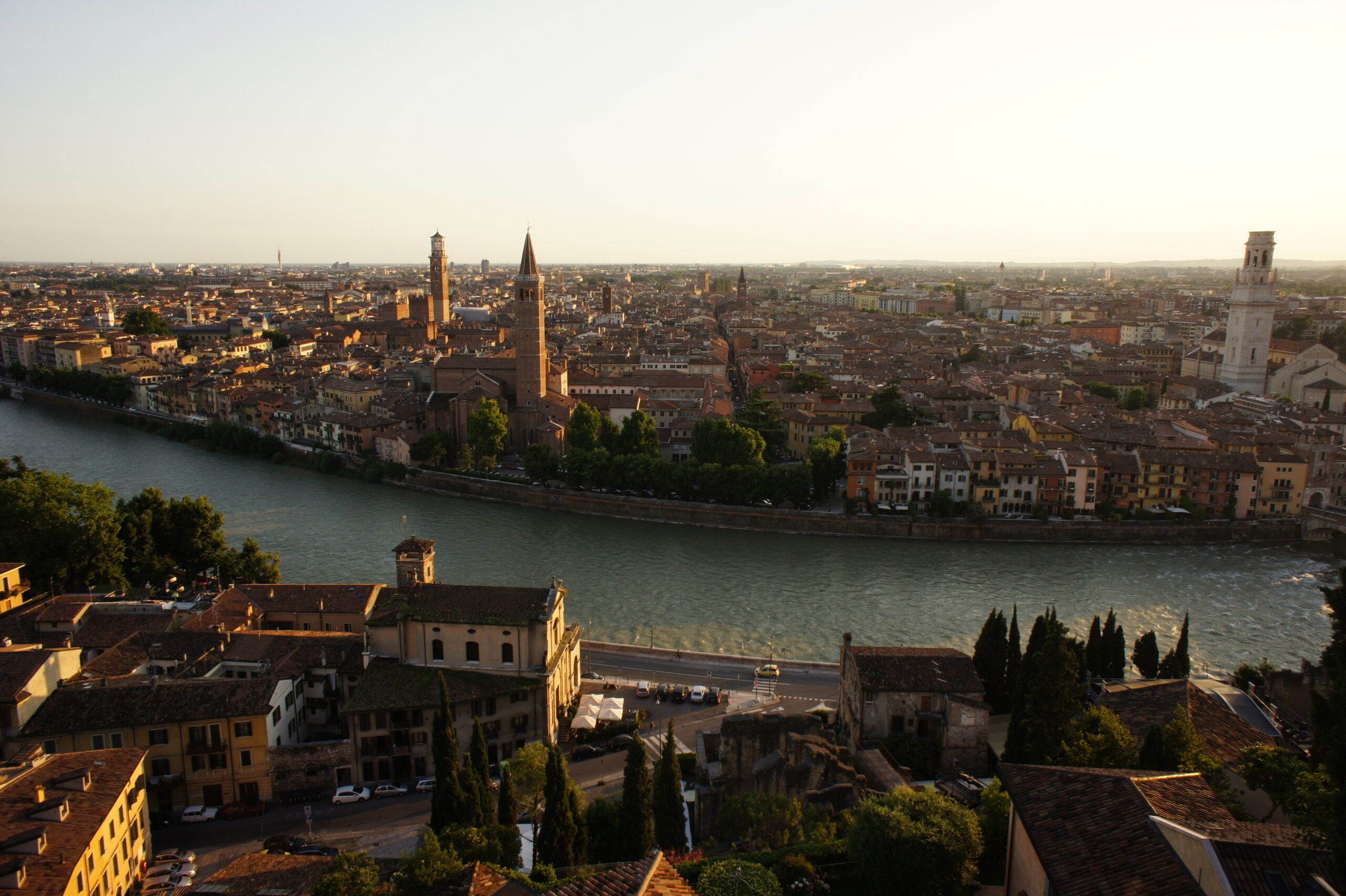
Think you’ve never heard of Verona? We know for a fact that’s not true. The northern Italian city is the setting of one famous Shakespeare play and one very famous Shakespeare play: The Two Gentlemen of Verona and Romeo and Juliet, respectively. Though the latter doesn’t have the happiest of endings, it does bring pre-Renaissance Verona to life. You can almost hear the wingbeat of martins as they dart across the Adige River and soar past the medieval Old Town’s bell towers and jasmine vines.
Verona isn’t the home of feuds and duels and double suicides anymore. Rather, it’s a sleepier version of its former grand self, perfect for a low-key detour when travelling between Venice and Milan. Its metro population of about 714,000 is also quietly queer-friendly. (Verona Pride usually happens in June.) That said, we wouldn’t be recommending it if it were just a party destination. The entire 2,000-year-old city is a UNESCO World Heritage Site stocked with Roman remains and literary pilgrimage sites. It might be worth grabbing some wine and risotto at the nearest osteria and planning your itinerary through this meandering city.
City of lovers (of all stripes)
Verona has many nicknames, but it often gets dubbed the Striped City for its many pink-and-white limestone buildings. The nickname that really draws crowds, however, is “City of Lovers,” which draws from the city’s connection to Romeo and Juliet. This isn’t just a gimmick, though. Romeo Montague and Juliet Capulet are based on real families—the Montecchi and Capuleti—who lived in Verona in the 13th and 14th centuries. These days, you can visit the house that’s said to have inspired Shakespeare (Casa Di Casa Di Giulietta, Via Cappello 23, Verona) and rub the breasts of Juliet’s statue for good luck. If you get tired of watching horny middle-aged men fondle Juliet, you can pay 12 euros to step inside her home and take pictures on her famous balcony.
But soft! That’s not the only famous Romeo and Juliet locale. You can also visit the Basilica San Zeno Maggiore (Piazza San Zeno 2, Verona), the Romanesque church where the real-life Romeo and Juliet supposedly got married. Admire the church’s ship hull–shaped ceiling before marching off to La Tomba di Giulietta (Via Luigi da Porto 5, Verona), a gloomy crypt where Juliet and Romeo met their maker.
You might want to get drunk after all that depressing teen romantic drama. Well, you’re in luck. Thanks to the work of local queer rights organizations, the city has a thriving, if small, queer population. You can find some of the local queens at the LGBTQ+-oriented Luclà Cafè (Via Marcantonio Bentegodi 4/A, Verona), where affordable drinks mix with a cozy space to create easy camaraderie, especially on weekends. The Veronese will surely make you feel at ease—this city is the former home of Dante, after all, so sinners roam freely. When you’re done for the night and you want to stay on theme, you can crash at the elegantly understated Hotel Giulietta E Romeo (Vicolo Tre Marchetti 3, Verona).